Showing posts with label Royal Opera House. Show all posts

Wednesday, 18 December 2013

Parsifal

Live cinema screening from Royal Opera House
Greenwich Picturehouse, London
18 December 2013

Pappano conducting the Prelude. Ends abruptly!  From here.

A intriguing, detailed approach to this masterpiece that may work better in a revival.

Child abuse can be avoided if both parents stop hurting each other and start over. I've no idea if that's true, but it has nothing to do with Parsifal, and director Stephen Langridge can't have intended that to be the main message of the evening. But his final scene was only the most disastrous example of bathos in this new production, though the good news is that he had many extremely interesting and good ideas, some of which I'll come to.

Parsifal's music is so beautiful that it's possible to enjoy the whole thing as a sort of enormous symphony with voices, and to neglect what is happening on stage, apart maybe from expecting some lovingly recreated medievalist and Christian images.

Comments overheard from my fellow audience members suggests that what they were doing, and the perfunctory introductory and interval discussions from Covent Garden didn't improve the situation.

But the meaning of this overwhelming work does matter. Clearly it is an exploration of the growth and nature of compassion, through the lens of a Christian myth. But a number of problems arise. I think the only serious problem is whether the piece is Christian at a deep level, or at any rate espouses an eccentric form of Christianity. Nietzsche thought so, and was disgusted.

He also claimed Wagner's characters were one step away from the hospital, and Langridge agrees in a literal sense. The set is that of a hospital in a forest, with Amfortas a suffering patient. Kundry is presented as if she ought to be a patient, suffering from hysteria. Indeed, this production plausibly makes Kundry the centre of the work.

That addresses another, less serious problem. The grail knights, usually presented favourably, are also criticised for mortifying their flesh. Kundry, presented superficially unfavourably, is shown to be at a different extreme, a sex addict. But is this really the other extreme from mortification? Is it so very bad? And is the work basically misogynist?

If anything, the production goes too far in rebutting all that. The grail knights are shocking. The grail is presented as a boy whom they bleed for their fuel. Meanwhile Kundry's problem is accurately shown to be one of uncontrollable mocking laughter, rather than hedonism. In the second act she is much less glamorous than the Flower Maidens, and seduces through her pitiable state.

All of this simplifies Wagner, but it's in the right direction. Unfortunately there are also a number of risible moments. It's fine to show the rejuvenated community as being open to women, but having Kundry and Amfortas leave the stage together implies they are about to start a new life together, an inane idea. I didn't understand the brief reappearance of the grail as a young man: this too seemed a wildly inappropriate joke.

A cinema screening requires many close ups of the acting singers. When the acting is as good as Angela Denoke's Kundry, this is wonderful. When it's as bad as Simon O'Neill's Parsifal, it's annoying or worse, comical. Some acting may work better in the theatre, such as Gerald Finley's Amfortas.

The acting overwhelmed the singing, for good or bad. I thought Denoke was underpowered, O'Neill indifferent and Finley probably excellent, but it was hard to tell. The other cast members were fine but in less important roles.

Antonio Pappano conducted so as to minimise any drama or tension in the score. If that wasn't as mutilating as it should have been, it is a testament to the production.

Sunday, 17 November 2013

Wozzeck

Royal Opera House, London
15 November 2013

Conductor Mark Elder's fascinating introduction to Wozzeck. From here.

Catastrophic mismatches manage to sink this astonishing masterpiece.

This is the second London production of this opera this year, presumably to celebrate the bicentenary of the remarkable Georg Büchner, author of the original drama, Woyzeck.

Berg’s music, and his adaptation as a whole, is so successful that it boggled the mind to realise the original drama is contemporary with Verdi and especially Wagner, and indeed written before either had achieved a mature style. However Büchner might have imagined his work set to music, it is certain he couldn’t have expected a post-Wagnerian, modernist idiom. Yet it works.

Or rather, it usually works. This production is a striking failure.

It’s as if there are three disconnected, even contradictory, planes attempting to intersect in the opera house. The direction/design, the acting and the music.

Director Keith Warner and the design team are most at fault. They make some terrible choices. The setting throughout is a laboratory, where Wozzeck (and maybe Andres) are experiments, so that the Captain becomes a closer associate of the Doctor than in the original drama / opera. This fatuous concept (konzept?) introduces a number of problems, most importantly how to handle the domestic scenes with Marie and her child.

Here, the domestic situation is in a corner of the stage, with an unclear relationship to the experiment. All this could simply be mistaken and misleading but not harmful: a reasonable effort to divine significance from this tawdry drama.

Much worse, Warner has Marie’s child onstage almost throughout, making the extremely heavy-handed observation that he is likely to grow up damaged. This point is hammered home in a final scene so sentimental I think even Puccini would have rejected it. Incredibly, it completely reverses the effect of both the original drama and of Berg’s own ending, where the child carries on playing oblivious to the deaths of his parents and the cruel taunts of his playmates.

Simon Keenlyside and Karita Mattila have beautiful voices and striking presence. They didn’t seem at all well suited to the staging. They belong to the expressionistic tradition, along with Berg himself, striking pained poses and not attempting to be naturalistic.

Arguably this is the correct approach for this opera, and would have worked well in an ‘authentic’ production, as the stills from the works’ premier suggest. But here it seemed exaggerated and jarring.

Musically, Mark Elder conducted in what is now the tradition with Berg, emphasising the beauty of the music. Again, this didn’t sit well with the drabness of the sets and the expressionism of the acting. His approach was measured, stately, giving something of the sense of a ceremony about the piece. It was enormously impressive, and built to some utterly shattering climaxes, as needed.

Overall, then, the effect was extremely peculiar, to the point of dullness, an emotion I don’t expect to experience here. A confusing, sentimental staging undermined by a religious approach to the music and a highly romantic approach to the acting.

Wednesday, 9 October 2013

Elektra

Royal Opera House
6 October 2013

Director Charles Edwards, and some of the 2008 cast, discuss the work. From here.

Some momentum goes missing in this performance, but it brings out the beauty of the score.

Strauss seems to have felt this opera and Salome could be performed with grace and lightness of touch, which seems especially odd in this jackhammer work. Conductor Andris Nelsons came close but I found his slow, transparent direction enervating despite it also being illuminating.

The programme contains essays describing various psychological aspects of the work, the myth and hatred in general. While these are interesting, they have only tangential relevance to this piece, and are reductionist.

If Elektra hates her mother Klytämnestra, this is more than reciprocated by a woman who also knows that her son is engaged in a life-and-death struggle with her. The relationship between the heroine and her sister Chrysothemis seems more complex than sibling rivalry – in expressionistic fashion, they reflect different sides of a whole, so that their antagonism is due less to their being related and more to do with contrasting approaches to their appalling situation.

Much of the original mythic background was removed by Hofmannsthal in his libretto, but Agamemnon’s violent death, his wife’s extreme cruelty and the disturbing revenge fantasies of their children are all too vividly realised for this to refer to passions you or I might readily share. These are heroic passions.

Elektra’s sudden death is poetically right, even if implausible. From the very start of her opening monologue (even before), the Agamemnon-motif makes it clear how all-or-nothing she has become, and this obsessive sense only weakens slightly following the recognition scene with her brother Orest, when she starts falling in love with the nostalgias, to music redolent of Salome.

Which music, of course, also suggests that obsession will return, and it does. What use has Elektra of life after she achieves her revenge? The all-consuming nature of her desires, and their almost unbelievable intensity, eventually kill her, though we aren’t sure that a life has been wasted, which may preclude tragedy.

So I suspect the appropriate approach to this work is to surrender to its tremendous visceral impact. Even a relatively muted performance as this one couldn’t fully blunt that.

The singers seemed fully in line with Nelsons, generally creating beautiful sounds and exploiting a huge dynamic range. Above all, Christine Goerke in the title role gave a committed performance, and generated a remarkable variety of tones. If the role perhaps requires greater hysteria, it’s hard to expect a singer to run risks with her voice.

Charles Edwards’ production was an unobtrusive updating to the 1920s, producing a suitably expressionistic feel. Unobtrusive, that is, apart from one blunder. For some reason a corpse kept moving around the stage, a distracting and bathetic idea.

Otherwise, he obtained fine, repulsive acting from everyone,

Wednesday, 22 May 2013

Don Carlo

Royal Opera House
21 May 2013 

Ferruccio Furlanetto (Philip II), eloquent at the opening of Act III. From here.

A good, but not great, production of an overwhelming masterpiece.

Verdi’s operas typically explore the standard, almost ubiquitous, suffering woman theme of serious Italian music drama. They also explore family relationships, like much of the non-musical theatre of the period. Only this work seriously examines existential concerns of our relationship with power and with faith.

Which is not to say Verdi didn’t employ his usual themes as a way to address these others. Elisabetta suffers, and Carlo has a murderous relationship with his father Filippo, but the overriding impression is rather the  painful way in which power and faith, while bolstering each other, do so only to make our lives worse.

Although the private scenes between Rodrigo and Filippo, then Filippo and the Grand Inquisitor, carry the weight of the work, that weight is created in the central public scene of the auto-da-fe, in which somehow Verdi succeeds in transfiguring the horrific. It is one of the most distressing scenes in all of art, yet oddly uplifting, as if the artist insisted that there must be a good outcome in the afterlife, contrary to all appearances.

Great voices are needed, but also good acting, and the production is critical. I’m not quite sure why Nicolas Hytner’s production doesn’t work for me, given its clear theatrical strengths.

For example, I hadn’t quite appreciated how indebted this work is to Scribe’s notions of a well-made play, in which every aspect contributes to the plot. Eboli’s song of the veil foreshadows her pretence in the garden, and so on. Hyntner is very good at this, but elsewhere presenting the opera as a grand old historical drama is detrimental, the costumes and pageantry a distraction.

Antonio Pappano has made this work something of a speciality, performing several different versions, and he and his orchestra endow the piece with beautiful, resonant tone. So I’m also not sure why I felt that both the conclusion of the auto-da-fe scene and the ending of the whole opera didn’t catch fire as in previous performances (pardon the pun).

The production also exaggerates Carlo’s role, with many scenes ending with him alone facing the grim façade of Filippo’s Escorial palace.

The voices were wonderful, being generally capable of both beauty and thrills. Unfortunately the acting was broad and conventional, a flaw also of the production.

La donna del largo

Royal Opera House
20 May 2013

Juan Diego Flórez, Joyce DiDonato and Colin Lee give some idea of the merits of this opera in their previous collaboration, in Paris 2010. 
From here.

Unbelievable singing and a thoughtful, striking production still cannot salvage a weak drama.

Quiz question: what opera features a woman singer who has to wear a skirt in order to be convincing as a man? Less a trouser role, then, than a kilt role. Is this a Rossinian joke?

John Fulljames' production employs a framing device: the work is apparently being created in the imaginations of early nineteenth century contemporaries of Scott, so that it takes place in an oak-panelled museum and culminates in a version of the British King George IV’s ceremonial visit to Scotland in 1822, which had genuinely been stage managed by Scott himself and concluded his invention of a romanticised Highland-focussed, tartan-and-kilt tradition of Scotland.

It’s probably useful to be reminded of Scott’s contribution to this nationalism, but it is confusing, and introducing peculiar anachronisms to the opera actually weaken the reference. There is little gained by turning the (Scottish) King and his soldiers into English redcoats. The Scottish tradition may have been invented after England had become the dominating force in the United Kingdom, but surely Scott intended his countrymen to be proud of their independent monarchical heritage?

What any of this has to do with Rossini and his librettists, and so with the opera, is a mystery. It seems to me the opera could plausibly be set anywhere, and while it is mildly concerned with patriotism, its real interest is in the tangled love story of its central character.

The production is handsome, and in general the stars look good. Ah, yes, the stars. Rather like Il Trovatore, this appears to require four of the best singers in the world, so it was just as well it got them.

It needs great singers because while some of the music is very beautiful, this tends to be the quieter, slower arias. Yet every aria, it seems, threatens to outstay its welcome, then proceeds to do exactly what it threatened by turning into a formidable cabaletta. The lack of variety made the evening something of a chore, though the voices were astonishing, and this was just about enough to maintain interest.

Rossini’s dramatic intentions coincide well with his style. His works, with almost any librettist, portray people as puppets, not really motivated by any inner sense. It’s as if we get the external show of emotion, but that as everyone gets the same musical treatment, that emotion is generalised.

This distinctive approach defines Rossinian comedy, a form of zany farce with pessimistic undertones. His comedies are near-masterpieces, but I think the approach is less special in the serious works, with only some parts of Guillaume Tell achieving a distinctive effect.

Perhaps this is because it is too easy to make melodrama a collection of generalised emotions, and Rossini doesn’t have anything new to add to the large number of eighteenth century opera seria in a similar mould.

Or does he? The ‘kilt role’ version of the trouser role may have been intentionally zany, and Fulljames only increases this factor with some very kitsch jarring effects such as rugged highlanders rum-ti-tumming on their shields, or the two male heroes heaving outsized swords for their duel.

Probably Rossini didn’t intend his beautiful harp ‘bardic’ music to be accompanied by the disembowelment of a sheep, but the effect gets the eyes rolling, and these are just the most obvious outlandish touches in this production.

That these peculiar effects didn’t seem to mar my experience of the opera may be the most effective criticism I can make of it. But the evening was enjoyable, just about, due to the voices. I can’t imagine the piece obtaining a better performance.

Sunday, 10 March 2013

Written on Skin

Royal Opera House, 8 March 2013

To the left of the stage, and above: the modern world of the angels.
To the right, the medieval world of the protagonists, one of whom is an angel. From here.
 
An ambiguous success for a work that might be better suited to a simpler theatrical treatment.

I knew nothing about this opera’s story when I watched this, and until I read the programme, I didn’t understand several important aspects of it.

Does this matter? I was impressed by the work, and willing to accept some things were mysterious, before I understood the creators’ intentions in the bits I didn’t understand. So the opera passed what could be called the Debussy test: I reacted favourably on first experience. 

But I’m not sure that the production can be regarded as a success if it doesn’t make clear what the creators intended.  

Specifically, this is supposed to be a drama managed, or recreated, by angels. A grisly twelfth century Occitan story is presented by these angels, resurrecting two of the three protagonists for our contemporary ‘enjoyment’, with the third protagonist (a boy) taken by another angel. 

I didn’t understand any of this. Better informed, on reflection, I still don’t understand why the stage was split, with the angels operating in our time and sometimes moving in slow motion relative to the re-enacted medieval scenario.

The two contrasting time periods (medieval, real people: contemporary, angels) only seemed to add a level of confusion to the drama, as did the poetic tendency of the medieval characters to talk about themselves in the third person. 

Such self-conscious theatricality isn’t new – it might be as old as Aeschylus – but I don’t see that it adds anything. I suppose it’s necessary to alienate the audience from a horrible event, and librettist Martin Crimp does his best here, given a myth about a man serving his wife the heart of her lover (the boy).

However, we are also well used to horrific acts on stage, and this isn’t especially disturbing. Crimp implicitly accepts this by focussing more on the wife’s rebellion against the order imposed by her husband, also referred to as the Protector. This is signified by her naming. She is the only character to receive a name, and this is clearly a step on her way to self-realisation, as something other than a possession. 

Onto this straightforward but powerful story, Crimp adds layer upon layer of unnecessary metaphor, as if doubting the power of his tale. The boy (and angel) is an illustrator of manuscripts, writing the biography of the protector. The metaphors tumble over one another, from the fall of Eve to the branding of Auschwitz inmates.

It’s all very dense, and the distancing effect of the angels, supposedly detached but in this production dubiously so, obscures rather than enlightens.

Remarkably, Crimp appears to be given priority over the composer, at least in the programme. But George Benjamin’s tasteful, unobtrusive music heightens every aspect of the narrative, and this is a greater achievement. 

The music is refined, by which I mean it is Pelleas-esque, and this makes it less insistent than most music dramas. But it seemed effective at maintaining and improving interest in this otherwise overloaded story.

Apparently the composer wrote with these voices in mind. I suppose this must be close to an ideal realisation of his music. As mentioned above, I've some doubts that Katie Mitchell's direction is a similarly ideal interpretation, but I suspect the work is unlikely to receive a better all-round performance.

Tuesday, 22 January 2013

The Minotaur


Royal Opera House, 21 January 2013

The first 15 minutes of the opera, from the 2008 production (on youtube)

A revival of Harison Birtwistle's 2008 work confirms it deserves attention for its unflinching depiction of the effect of violence on the spirit.

The programme notes confirm what is clearly shown on stage; that librettist David Harsent is uncomfortable about notions of the heroic.  

I don’t mean this as a criticism; or perhaps I mean to suggest that this drama does not attempt to present a credible heroism. The kind of things heroes did – for example Theseus, the hero here – are no longer the kind of things most of us can value in any thought-provoking work.

However, the Minotaur, while sympathetic, is still monstrous, and this is something we can find credible, though often are not asked to. Instead, we are either given an unsympathetic villain or if we feel sympathy for him, he turns out to be much less villainous than we originally thought. 

Not so here. The Minotaur commits acts of grotesque violence, and no acts of kindness. His freakish appearance (and half-beast nature, as he and everyone else feels it) combined with his deprivation in the dark prison Labyrinth, combine to produce a plausibly vile disposition. Wretchedness breeds villainy, and it is not relevant that of course not all wretched people are villains, any more than all villains lead a wretched life. 

The Minotaur is not an anti-hero, for contrast with the hero Theseus. He is a villain, a monster, very well characterised. Here, Theseus is more the anti-hero, brave and well-intentioned but also pragmatic, unscrupulous and happy to murder his half-brother, for both he and the monster were fathered by the Sea God.  

[This last trait, while to us no worse than being happy to murder someone unrelated, was regarded by the ancient Greeks as a vile crime. More might have been made of this in the drama, but in any case Theseus is deliberately unmemorable.] 

Ariadne is more central to this drama than either the anti-hero or the titular monster. If she was present in the final scenes, this could even be described as her tragedy. Fearful and wanting to escape her homeland, she clutches at the straw promise Theseus makes to leave with her to Athens, though his subsequent desertion of her on Naxos is foreshadowed in the very opening of this work, as she walks lonely along the Cretan beach.
 
Birtwistle has tended towards both myth and violence in his operas, and here I think he finds the perfect subject. He depicts a violent, cruel world with appropriate music, including, surprisingly, very warm music on occasion when either the Minotaur or Ariadne are feeliong sorry for themselves, as well they might.
 
I think this uncharacteristic occasional venture into sentimentality is absolutely vital for this work. It humanises the effects of the violence and despite ourselves we feel pity for all those affected.
 
The flavour of ancient Athenian tragedy is captured by Birtwistle and Harsent. We don't leave the theatre feeling happier, or with greater understanding of our terrible condition, but we do experience it properly, and are repelled by it.
 
Cast, conducting and playing is all of the highest standard. Direction, sets and designs are unobtrusive and right. I hope this opera enters the canon.
 

Sunday, 23 December 2012

Cendrillon


Royal Opera House DVD, 2012

One of the coloratura highlights, which give a good indication of the rest of the work.
From youtube. 

Beautiful, boring and empty, this version of the fairy tale cannot be saved even by an amazing cast.

Once a popular composer, the hundredth anniversary of Jules Massenet’s death passed almost unnoticed in London, so I’ve opted for reviewing a 2011 Royal Opera production of his opera Cendrillon (Cinderella) on dvd.

Active during the decadent late nineteenth century when the concerns of high romanticism had become weary, the composer is most well known for his self-consciously lush sentimentality, allergic to the idea of a greater significance.

The director, Laurent Pelly, has done marvels with comic music dramas, from Rameau through Offenbach. Here, it is hard to tell if the tone of the piece reflects Massenet’s intentions, or Pelly’s comic interpretation, not that there is much humour amidst the camp.

Massenet and his librettist Henri Cain somehow manage to increase the sentimentality of the original Perrault folk story, so that it becomes so cloyingly sweet that it can only be intended as a kind of satire on the composer’s other works which are usually in a similar, though more explicitly realistic, vein.

This is an especially self-conscious work, which assumes familiarity with the story, but more than that, assumes that the audience will find the story naïve, and does nothing to dislodge that prejudice.

Comparison with Rossini’s earlier masterpiece Cenerentola seems useful. Both composer/librettist teams are faced with the same problem, of how to set a familiar story.

But Cenerentola, written in the first period of romanticism, is much the more lively work, compared to the deliberately tired approach at the other end of the century.

Where Rossini and librettist make Cinderella’s relatives unpleasant and at points extremely cruel, Cendrillon’s relatives are merely vain or weak-willed. Where the Italian prince is energetic and clever, the French hero is insipid and languorous. And most fatally, where the earlier drama maintains tension, the later one almost entirely removes it, so that we are almost always certain of a happy ending.

Musically, the piece is one long wallow in swooping strings, harps and long-breathed melody, broken with bright ‘magical’ coloratura or snatches of dance tunes attempting to evoke the elegance of the past.

Taking its description as a fairy tale literally, the opera makes great use of the fairy, who controls everything so completely that she might as well have written the tale, which is helpfully implied at the end of this production.

Unable to find any deeper interest in the work, I was left admiring the costumes and the singers. Pelly designed the former, which may explain his involvement.

The singers were perfect, and much better than the work deserved. Joyce DiDonato must have given the definitive performance of the title role, though I’ve no wish to sit through another performance to compare.

Ewa Podles has one of the darkest contralto voices I’ve heard, and gave good front as the snobbish stepmother, but Eglise Gutiérrez stole the show as a camp, busty, stratospheric fairy.

Bertrand de Billy’s conducting was soporific, though I don’t see how he could have energised this score. 

No amount of magnificent singing or costuming can bring this work to life; Massenet’s claims to our attention must lie elsewhere.

Saturday, 22 December 2012

Robert le diable

Royal Opera House, 21 December 2012


The ballet of undead satanic nuns from Robert le diable, painting by Edgar Degas (1876).
From the V&A museum.
A talented cast and creative team cannot revive a lifeless treatment of a misguided 'virtue vs pleasure' myth.

Once hugely popular and influential, Meyerbeer's operas are now extreme rarities, even less popular than those of Gluck. But whereas Gluck deserves, and could surely sustain, a proper revival, I think posterity has judged Meyerbeer fairly.

I wouldn't dispute his importance, as his 'grand operas' established conventions for everyone else in the nineteenth century: tight plotting, a contrast between grand public scenes and intimate family relationships, and some form of redemption or heroic sacrifice.

But there is a great gulf between his ambitions and his achievement. The obvious comparison, in terms of themes, is with Wagner, but this is ridiculous. Even without examining the purpose to which Wagner's orchestral soundworld is put, its effect on us is radically different from Meyerbeer's, and in every sense greater.

A more useful comparison is with Verdi, who wrote at least two explicitly Meyerbeerian masterpieces (Don Carlos and Aida) or with Mussorgsky, whose two operas seem to me the pinnacle of what Meyerbeer is usually considered to be attempting, which is something political.

Mussorgsky first, because easiest. His rejection of conventional melody through his use of the rhythms of ordinary speech is extremely powerful for conveying the political world. It is also an innovation that places him in a different universe to Meyerbeer, for whom tunefulness is an axiom.

Verdi is the harder comparison. He seems extremely similar to Meyerbeer, in both approach and strengths (much moreso than Wagner).

Unhelpfully, I would describe the difference with the word gusto, as used in Hazlitt's crucial essay. Verdi's music gives his characters life in a way that Meyerbeer's cannot, beautiful though it sometimes is. Or rather, Meyerbeer only occasionally achieves this, and not so far as I heard in this particular opera.

His music is notoriously challenging for singers, and perhaps with a suitable cast it might come to life. But that is a serious criticism of it, as Verdi too blooms fully with great singers, but as with other great opera composers, his music works perfectly well without them.

I've now strayed into reviewing this production, and implied that the cast weren't great. They were only very good, which of course is not 'only' at all. Outside of New York, we're unlikely to get a better cast, so I'm not going to dwell on it.

In any case, I was more interested in the direction of Laurent Pelly, a director of comic opera whom I greatly admire.

He develops all of the presumably unintentional aspects of this version of the Faust myth. Comedy seems the correct tone for a story about a hero's indecision between heaven and hell, especially when this choice is mediated by his parents, the first dead and so speaking through Robert's saintly 'sister' Alice, the second alive and in vigorous malevolent health as Bertram, his diabolic new friend.

Equating hell with pleasure, especially sexual pleasure, effectively hobbles even the greatest artists, so that even Wagner cannot convince us that we should want heavenly non-pleasures, no matter how hard he tries, and this is very hard, in his Tannhauser.

Meyerbeer and his creative team don't even try to convince us. His dreary heaven wins only because the game is rigged: Robert doesn't choose, he merely vacillates until hell's (and Bertram's) time is up.

With considerable hindsight, it is clear that the supposed tension between virtue and pleasure explored so obsessively by the early nineteenth century romantics was a false dichotomy. In those works where the Faust legend retains its appeal, it is because the artist didn't centre their work on that dichotomy.

In rendering this opera as fundamentally comic, the production makes it entertaining once again, but I left suspecting Meyerbeer would be almost as unquiet in his grave as his famous satanic nuns.

Saturday, 1 December 2012

L'elisir d'amore

Royal Opera House, 28 November 2012
 
Enrico Caruso singing Una furtiva lagrima from this opera in his 1904 recording.
Magnificent singing, though the opera would probably work better without this aria!
 
A committed cast and engaging production make the most of this charming, almost flawless masterpiece.

L'elisir d'amore (the love potion) is an undemanding, charming comedy. I didn't find it funny, even in the experienced hands of original director Laurent Pelly and the director for this revival, Daniel Dooner. Comedy is extremely hard, and music comedy seems to be even harder.
 
The integration of music with a comic drama can heighten the mechanical sense of a farce, as in the zany, cruel operas of Rossini. It can also add emotional depth as in Mozart, with the sense that these are real people and that in real life, the drama would have the opposite of a happy ending. Sometimes it can heighten the actual humor, as in the works of Offenbach and his best librettists Halévy and Meilhac.

Most often, it is used to add charm and interest to what might be thin stuff in a non-musical drama. That is what happens here.

The composer is helped by a strong plot, adapted from that master of plotting Scribe by the talented Romani. Strong in the sense that the many implausibilities do not include anyone acting contrary to their estabilished character. The implausibilities are 'external'.

Nonetheless, a long unfunny comedy with just 5 singing characters, one of whom is extremely minor, could easily bore. Donizetti keeps everything tuneful and charming, while generally avoiding any attempt at pathos.

With one exception. The tenor aria Una furtiva lagrima, extremely famous at least since Caruso sang it so perfectly, is a misguided addition to the work. It is lachrymose and pointless, especially as the audience already knows that Nemorino has won Adina.

This overall economy of means has to rely on the chorus to achieve variety, and Pelly/Dooner excel in breathing life into these villagers, with judicious use of actors among the singers.

The chemistry between Adina and Nemorino is the other key to the success of this production. Clearly part of this is the director's skill, as it has worked with different singers, but this time round the interaction was noticeably improved, which is to the credit of Aleksandra Kurzak and Roberto Alagna, respectively.

Alagna was completely convincing in his role, which might sound like a backhanded compliment as Nemorino is described by his rival Belcore as the village idiot, and is sometimes played like that. But this Nemorino was charming, energetic, playful and trusting, and finally generous towards Belcore.

Nothing in the libretto or score requires him to be an idiot; rather he is effectively crazed by hope, even if in the end his hope is rewarded. Mozart and da Ponte might have made more of that, and made us aware of the fallacies of hope, but that would be a very different work.

As the quack Dulcamara, Ambrogio Maestri reminded me of Verdi's Falstaff, and I don't think that is only because he is alarmingly corpulent. Impressively self-aware, to the point of admitting Adina is smarter than he is, and almost as credulous as the villagers when it seems his wine might actually work as a love potion. And then leading the villagers in a final chorus praising his elixir, which happens incidentally to praise wine.

I wasn't in the mood for a comic opera at the start of this evening. When I left Covent Garden, I was buzzing and cheerful.

Friday, 30 November 2012

Triple bill: Kenneth MacMillan

Royal Opera House, 27 November 2012
 
Requiem (1976), Richard Cragun. Photo © Leslie E. Spatt. From here.

Three ballets illustrating what can be done with dance, though camp is an unpleasant companion in each, whatever its other strengths and weaknesses.

This tribute to the Royal Ballet's former choreographer comprised Concerto, Las Hermanas and Requiem, the last itself a tribute to choreographer John Cranko.
 
The pieces were well chosen to show the range of modern choreography. The first was abstract and undramatic, the second dramatic and tragic, the third abstract yet dramatic and poignant.
 
Concerto, to Shostakovich's second piano concerto, seemed to me the least successful work, though this may have been due to being placed first in the bill. It stressed the delightful aspect of the concerto, with perky ensembles in bright colours, much leaping and prancing and some forced smiles from the straining dancers.
 
Choosing this concerto in the first place was a great idea, given its relentlessly tuneful nature. But the finale was taken much slower than it would have been in a normal concert, and while this is an understandable concession to dancing, the effect further reduced the presence of intoxicating dionysus in favour of serene apollo.
 
The piece also highlighted what seems a common problem with dancing to anything other than a minimilist score. There is at least one moment in the slow movement where the emotional involvement deepens, and this wasn't reflected by the dancing.
 
Emotional intensity was if anything a little overdone in Las Hermanas, a short tale of repression, lust, sibling rivalry and finally suicide. The dancing was extremely expressive, but the result was more hothouse melodrama than proper tragedy. I think this must be because the timeframe was so compressed. We didn't receive a full impression of each of the relevant characters.
 
A striking aspect of this work is its negative portrayal of men, or at least, the only male character, who is so priapic that at one point he rests on his haunches like a sexually frustrated ape. MacMillan is deft at portraying his obvious appeal to the sisters, but given his one-dimensional sexualised nature, without even courage, so that he runs when threatened by the aged mother, he is a weak point in the drama. Can these women really be so passionate over such a trivial figure?
 
I don't want to be too negative. If it is a weakness to portray the man as one-dimensional, this at least inverts the usual situation of the one-dimensional sexpot woman.
 
Requiem is clearly intended to be a Major Statement. Any audience member applauding during the scene changes was shushed by the conductor, ballet veteran Barry Wordsworth.
 
It's extremely impressive, though the effect on me ranged from mild disgust to sorrow, a range probably not intended by MacMillan, and certainly not by composer Faure, though his mass for the dead normally affects me in this way.
 
I suspect that having chosen this particular piece of music, there was little chance MacMillan could have effectively subverted its sentimental, candles-and-incense catholicism. He certainly tries, and the result is surprisingly moving, a series of tableaux representing the the masculine and feminine parts of a soul presumably passing into the afterlife, and its effect on the community they leave behind.
 
Camp was not wholly avoided: pastel lighting, noble expressions and, in particular the shuffling company at the very beginning. But the overall effect was the best interpretation of this music I've experienced.

The distancing, belittling effect of camp seemed close to the surface in each of these pieces, what with the bright prancing of Concerto, the impression of drag-queen hysteria in Las Hermanas, and the pastels of Requiem. On reflection, I don't feel any of these pieces needed a camp element for their efectivenesss, so conclude it is either intrinsic to MacMillan or to the current production of these works.

Performances were exceptional, and it would be unfair to single any out, though I can't resist praising Zenaida Yanowsky in Las Hermanas if only because of her elongated frame and her commitment to exploiting this oddity to the full in her interpretation. Inspired casting and brave acting.

Friday, 5 October 2012

Der Ring des Nibelungen


Royal Opera, 24 September - 1 October 2012

Brunnhilde mourns Siegfried, Götterdämmerung. From Royal Opera website.
The end of the love that was supposed to redeem the world.
It is confusing to see how this could be, either in Wagner's idea or in this particular production. 

Many interesting ideas, but key aspects of this genuinely extra-ordinary drama go missing, both theatrically and musically.

The Ring Cycle is a powerful example of mythmaking and a profound critique of the possibilities of improving our relations with one another. It also places massive demands on both theatres and audiences, starting with simple endurance – how to interpret, or respond to, 14 or so hours of intense music drama.
 
Theatres with the resources and ambition to tackle it seem to approach it from one or other of two performing traditions that have emerged.
 
They might try to present the work as closely as possible to Wagner’s original, fairly literal, theatrical intentions. Or they might interpret the various layers of symbolism in a ‘modern dress’ sense.

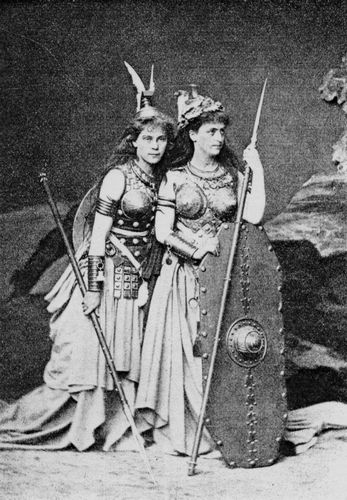
The legendary Lilli Lehmann (right), as a valkyrie.
An example of the first tradition, of keeping to Wagner's intentions.
Both of these traditions have problems – in the first, the risk of embedding the drama in a sword and sorcery fantasy world, in which deeper meanings might be missed; the second approach generally confuses through the mismatch between what is said and what is happening on stage, a confusion further heightened by the new layers of symbolism.

Keith Warner’s production is in this second tradition, and doesn’t avoid the problems I’ve mentioned. First-time Ring-experiencing companions asked me why Wotan jumped into a pit rather than lead his fellow gods upwards into Valhalla at the end of Das Rheingold. Or why the Rhinemaidens were dressed like a shabby chic variety troupe in the final act of Gotterdammerung.
 
Even if I felt I could answer these questions, they were two of perhaps two dozen that might reasonably have been asked, and I’m not confident I could answer them all – I was especially perplexed in the second act of Siegfried, with the woodbird being both a symbol of the hero’s youthful imagination and the youthful version of himself.

Maybe these confusions only enhance the attempt to achieve myth, and I did feel that Warner could have answered any question, so deeply has he thought about this production.
 
But the production also repeated several fatal mistakes that are part of this tradition, but which needn’t be – I wonder why they persist?
 
Firstly, the gods are presented as corrupt from the moment we see them, and we see a young Wotan long before Wagner intended, at the very beginning, carrying out his mutilation of the World Tree. As the gods have all of the flaws Wagner intended, but little of the compensating grandeur, they are both deeply unsympathetic and hard to distinguish from the corrupt human world of the Gibichungs in Gotterdammerung.
 
Wotan siezing the ring from Alberich, in Das Rheingold. From Royal Opera website.
As this image suggests, it isn't easy to distinguish these characters in this production.
When the concept starts like this, it is almost inevitable that the final conflagration will have to be visually bathetic – in this case gold statues of the gods being lowered into fire. An unsympathetic Wotan is even more disastrous, given the centrality of this complex character. By the end of Siegfried, he appears as a (violent) student in his bedsit, sullenly discarding his possessions in a fit of pique.

The second mistake, arriving like clockwork, is a bullying, unsympathetic portrayal of Siegfried. This is more understandable, as his characterisation needs a director of genius in order to reflect what Wagner for once cackhandedly intended. For Siegfried is the man of the future as well as dragon-conquering strongman. Not much sign of this here.

Mime's cave, first act of Siegfried. From Royal Opera website.
Where Wagner's dramatic and musical needs demanded a forest, or at least natural beauty, we see post-industrial waste.
A third mistake is for sets to be almost unremittingly ugly. I suspect the reason for this is to illustrate how, over the course of the drama, the natural world is corrupted and destroyed by our interventions, ‘our’ here being whether god, dwarf, giant or human.

So it reflects our views on ecology, which have intensified since Wagner’s time. I don’t want to suggest producers should ignore these concerns, which are absolutely in the Ring, but such a simplistic visual approach is as harmful to understanding as focussing on horned helmets and realistic dragons. 

Although I feel these three cardinal mistakes sink this production just as they sink all similar productions, I found many individual aspects to admire.

It seems that productions in the second tradition are chosen by teams with a strong commitment to realistic acting, and there were many thought-provoking moments between characters, or even whole scenes.

The Rhinemaiden scene mentioned above for instance, was charmingly comic, and an inspired interlude before things got extremely serious. Or Siegfried showing a sensitive side to Mime when the wretched dwarf is finally forced to reveal something about the hero’s parents.

Some of the symbols worked well over the course of the dramas, with the Tarnhelm later forming the Gibichung Hall; or Wotan’s Rheingold treaties forming a damning pile in the second act of Die Walkure, then appearing in the insouciant hands of the Wanderer in Siegfried; or a veil with horrible significance in Rheingold reappearing in Hagen’s case in Gotterdammerung. 

My mixed, but generally negative, feelings about the visual side of the production continue with the musical side.
 
In particular, I disliked the conducting. Antonio Pappano gave us beauty, with occasional intense or even ferocious touches, as with a magnificent Funeral March in the fourth part. But I also found myself unsettled and generally bored with the music, which implies he didn’t grasp its flow. The finale of Siegfried was especially dispiriting, with none of the soaring rhapsody I expected.
 
The singers were generally much more consistent, with Susan Bullock an especially radiant and heartfelt human Brunnhilde, though generally not convincing as a goddess in her first act.
 
Bryn Terfel’s Wotan was memorable, and for reasons consistent with the production, which is not to say I thought it did the character justice: a lot of anger, little beauty or nobility. Volke’s Siegfried was disappointing in his first act, but was clearly saving his voice, as he at least managed to sing all the way through. That this is cause for relief suggests I set the bar very low. I didn’t notice any great beauty or even variety in his voice, and his acting wasn’t a highlight.
 
Other roles varied from good to excellent, with only the Alberich and the Gunther not meeting the highest standards.