Tuesday, 9 October 2012

The battle over Mendelism

Royal Society, 5 October 2012
 
The reverse of the Darwin medal. From the Royal Society website.
Although intended to commend achievements, do these awards also stifle debate?

A forgotten dispute over heredity reveals prejudice in the way true theories are established.

How does science progress? Which is also: how do we learn the truth about our world?

In the past, these questions seemed less important than what the truth might be, or what we mean by truth.

But at least since Thomas Kuhn published his historical, sociological work on how specific scientific revolutions happened, we’ve realised that the actual process is worth studying.

This is different from say, ‘do atoms exist?’ We might have all sorts of opinions on that question, but the sociology of science is interested in how we came to believe that atoms exist, or at least that we came to care about their existence.

And this isn’t as academic as it might first appear, as this public lecture at the Royal Society illustrated.

We heard about the role of the society in the early days of genetics. It can seem hard to believe, but only a century ago, not only were words like genome and DNA not yet coined, but the very idea of genetics was new and questionable.

Genetics is a theory of heredity – a proposed mechanism for how characteristics are inherited. And as should happen with any theory, when it emerged, some people were sceptical.

According to Gregory Radick, the ideas of Mendel were ignored for several years, then reappeared with venom at the turn of the twentieth century, championed by William Bateson. His friend Raphael Weldon disagreed, and the Royal Society, smelling a potential academic controversy, duly stirred one.

This leads to the sociology. According to Radick, the Society employed three 'hard Cs' in order to facilitate progress– communications (better, controversy, I think); committees and commendations. In short, it emerged that Bateson was the better controversialist, manipulated the channels of patronage and then capped his victory by receiving the prestigious Darwin Prize and effectively closing debate.

OK, that’s putting it far too cynically, and the disagreement was much less rancorous than my summary suggests. But the confirmation of the truth of Mendelism didn’t happen by experts recognising it as true, through an exhaustive intellectual debate.

In fact, Radick claims that with Weldon’s premature death, his masterful alternative to Mendelism wasn’t published, a sad fact Radick and his colleagues at the University of Leeds intend to rectify soon.

Does it matter? We now accept Mendel discovered the truth, even if we have a significantly modified version of his basic idea. But its in the modifications that we see the results of this early debate, and others. Bateson – and his followers – apparently incorporated the early criticisms into their new version of heredity.

Then it’s a question of counterfactual. What would have happened if the debate had run differently, and Weldon had won it?

As Mendelism is true, we would expect some version of it to have survived regardless. But perhaps a Weldonian version of heredity would incorporate Mendel’s insights yet be more broadly in line with our current complex view of genetics. This, at least, is what Radick claims.

He plans to produce, in the long term, a textbook that will adopt a broadly Weldonian approach to genetics. Then, we will be able to see for ourselves how much the Royal Society may have influenced our understanding of the truth.

Friday, 5 October 2012

Der Ring des Nibelungen


Royal Opera, 24 September - 1 October 2012

Brunnhilde mourns Siegfried, Götterdämmerung. From Royal Opera website.
The end of the love that was supposed to redeem the world.
It is confusing to see how this could be, either in Wagner's idea or in this particular production. 

Many interesting ideas, but key aspects of this genuinely extra-ordinary drama go missing, both theatrically and musically.

The Ring Cycle is a powerful example of mythmaking and a profound critique of the possibilities of improving our relations with one another. It also places massive demands on both theatres and audiences, starting with simple endurance – how to interpret, or respond to, 14 or so hours of intense music drama.
 
Theatres with the resources and ambition to tackle it seem to approach it from one or other of two performing traditions that have emerged.
 
They might try to present the work as closely as possible to Wagner’s original, fairly literal, theatrical intentions. Or they might interpret the various layers of symbolism in a ‘modern dress’ sense.

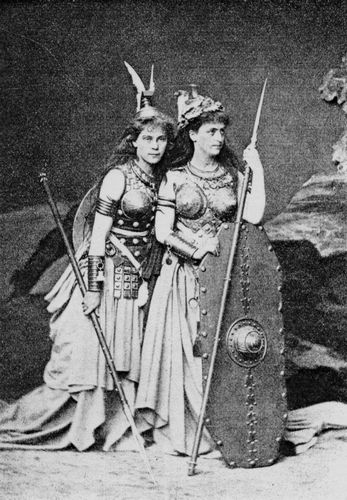
The legendary Lilli Lehmann (right), as a valkyrie.
An example of the first tradition, of keeping to Wagner's intentions.
Both of these traditions have problems – in the first, the risk of embedding the drama in a sword and sorcery fantasy world, in which deeper meanings might be missed; the second approach generally confuses through the mismatch between what is said and what is happening on stage, a confusion further heightened by the new layers of symbolism.

Keith Warner’s production is in this second tradition, and doesn’t avoid the problems I’ve mentioned. First-time Ring-experiencing companions asked me why Wotan jumped into a pit rather than lead his fellow gods upwards into Valhalla at the end of Das Rheingold. Or why the Rhinemaidens were dressed like a shabby chic variety troupe in the final act of Gotterdammerung.
 
Even if I felt I could answer these questions, they were two of perhaps two dozen that might reasonably have been asked, and I’m not confident I could answer them all – I was especially perplexed in the second act of Siegfried, with the woodbird being both a symbol of the hero’s youthful imagination and the youthful version of himself.

Maybe these confusions only enhance the attempt to achieve myth, and I did feel that Warner could have answered any question, so deeply has he thought about this production.
 
But the production also repeated several fatal mistakes that are part of this tradition, but which needn’t be – I wonder why they persist?
 
Firstly, the gods are presented as corrupt from the moment we see them, and we see a young Wotan long before Wagner intended, at the very beginning, carrying out his mutilation of the World Tree. As the gods have all of the flaws Wagner intended, but little of the compensating grandeur, they are both deeply unsympathetic and hard to distinguish from the corrupt human world of the Gibichungs in Gotterdammerung.
 
Wotan siezing the ring from Alberich, in Das Rheingold. From Royal Opera website.
As this image suggests, it isn't easy to distinguish these characters in this production.
When the concept starts like this, it is almost inevitable that the final conflagration will have to be visually bathetic – in this case gold statues of the gods being lowered into fire. An unsympathetic Wotan is even more disastrous, given the centrality of this complex character. By the end of Siegfried, he appears as a (violent) student in his bedsit, sullenly discarding his possessions in a fit of pique.

The second mistake, arriving like clockwork, is a bullying, unsympathetic portrayal of Siegfried. This is more understandable, as his characterisation needs a director of genius in order to reflect what Wagner for once cackhandedly intended. For Siegfried is the man of the future as well as dragon-conquering strongman. Not much sign of this here.

Mime's cave, first act of Siegfried. From Royal Opera website.
Where Wagner's dramatic and musical needs demanded a forest, or at least natural beauty, we see post-industrial waste.
A third mistake is for sets to be almost unremittingly ugly. I suspect the reason for this is to illustrate how, over the course of the drama, the natural world is corrupted and destroyed by our interventions, ‘our’ here being whether god, dwarf, giant or human.

So it reflects our views on ecology, which have intensified since Wagner’s time. I don’t want to suggest producers should ignore these concerns, which are absolutely in the Ring, but such a simplistic visual approach is as harmful to understanding as focussing on horned helmets and realistic dragons. 

Although I feel these three cardinal mistakes sink this production just as they sink all similar productions, I found many individual aspects to admire.

It seems that productions in the second tradition are chosen by teams with a strong commitment to realistic acting, and there were many thought-provoking moments between characters, or even whole scenes.

The Rhinemaiden scene mentioned above for instance, was charmingly comic, and an inspired interlude before things got extremely serious. Or Siegfried showing a sensitive side to Mime when the wretched dwarf is finally forced to reveal something about the hero’s parents.

Some of the symbols worked well over the course of the dramas, with the Tarnhelm later forming the Gibichung Hall; or Wotan’s Rheingold treaties forming a damning pile in the second act of Die Walkure, then appearing in the insouciant hands of the Wanderer in Siegfried; or a veil with horrible significance in Rheingold reappearing in Hagen’s case in Gotterdammerung. 

My mixed, but generally negative, feelings about the visual side of the production continue with the musical side.
 
In particular, I disliked the conducting. Antonio Pappano gave us beauty, with occasional intense or even ferocious touches, as with a magnificent Funeral March in the fourth part. But I also found myself unsettled and generally bored with the music, which implies he didn’t grasp its flow. The finale of Siegfried was especially dispiriting, with none of the soaring rhapsody I expected.
 
The singers were generally much more consistent, with Susan Bullock an especially radiant and heartfelt human Brunnhilde, though generally not convincing as a goddess in her first act.
 
Bryn Terfel’s Wotan was memorable, and for reasons consistent with the production, which is not to say I thought it did the character justice: a lot of anger, little beauty or nobility. Volke’s Siegfried was disappointing in his first act, but was clearly saving his voice, as he at least managed to sing all the way through. That this is cause for relief suggests I set the bar very low. I didn’t notice any great beauty or even variety in his voice, and his acting wasn’t a highlight.
 
Other roles varied from good to excellent, with only the Alberich and the Gunther not meeting the highest standards.

Tuesday, 2 October 2012

Edvard Munch: The modern eye


Tate Modern, 28 June - 14 October 2012
 

Edvard Munch: Self-portrait. The night wanderer. 1923-4.
Munch museet.

A major Tate Modern exhibition serves to reveal its subject as a latecomer rather than an innovator, despite its claims.

Sometimes curators claim too much for their subject, and here is a case study. Whatever might be said of Munch, I saw nothing in this exhibition to suggest he was a precursor of modernism, or modern in any other significant respect, aside from the fact he died in 1944.
 
The curators claim his aged self-portraits are unflinching depictions of his fragility, yet whether he had just experienced a life threatening illness, or was so old that death must have seemed imminent, Munch consistently portrayed himself as a hero, intense, stoic, resolute.
 

Edvard Munch: Self-Portrait: Between the Clock and the Bed 1940–3
Munch Museet

On the evidence of this exhibition, which collects photographs, woodcuts, prints, drawings, paintings, sculptures, even amateur films, the artist’s self image was the same throughout his life, at all ages. 

Given the failure of these curators to make him modern, I feel confident in asserting that Munch was a late Romantic, in fact a Decadent, his whole life, regardless of the changes that surrounded him.
 
Almost everything about his art confirms that he was born too late, with the partial exception of his chosen media, though it is clear his reputation will continue to rest on his paintings rather than his photography and films.

Some of the rooms are impressive despite contradicting the curatorial plan. A room of some of his more well-known paintings in early and later incarnations is interesting. Munch compulsively repainted his earlier ideas, though I think the general rule is: earlier is better.
 
Perhaps as time passed and he became more detached from his preferred period, which is clearly the late Romantic twilight of vampires, screams, nights and forests, the harder it became to recapture his original inspiration.

Well then, a belated figure. How does he stand, considering his concerns in themselves, so far as we can assess this? Pride, obsession, angst: these are his High Romantic themes, and as we might expect from a decadent version of romanticism, his art induces unease, claustrophobia, spleen, even nausea.
 
Colours clash; faces (or masks of such) are prominent; viewpoints are vertiginously dramatic. The exhibition is useful in showing he had more ways of achieving these effects than I thought. Not everything is wibbly-wobbly.
 
A room filled with minor variations on a single theme – a downcast near-naked woman – made me think that having a good visual idea mattered more to him than anything else, and he recreated it in various media. So at his best he is an imaginative graphic artist, with descendents in that field science fiction, comic books, poster design.  

Having a characteristic approach is a strong selling point for an artist, and Munch had that. But if we compare him with his older contemporary, Ibsen, for whose dramas he sometimes produced scenery, we discover his limitations. Munch’s best paintings reflect our doubts, our fears. Ibsen takes this basic material and uses it to investigate how we might overcome these anxieties, whether successfully or not. 

Friday, 28 September 2012

Mademoiselle Julie


Barbican theatre, 24 September 2012
 
Mlle Julie. From the Barbican website.
A surreal production of Strindberg's drama highlights the hysteria while downplaying its underlying tragedy.

Two glamorous women, one older and supposedly more powerful, struggle for the heart of a ruggedly handsome, cynically poetic menial. This struggle takes the form of lengthy dialogues in cool white interiors, focussing on the nature of love, class and death. Jump cuts disorient the viewer, as does the tendency of characters to switch from screaming hysteria to calm philosophising. A white rabbit appears occasionally, along with other surreal touches. And very little happens.
 
If I add that Juliette Binoche is the lead character, surely I’m not being fanciful to think this is Strindberg reinterpreted as a French period Buñuel film.
 
The rabbit. Adding a touch of surrealism from Wonderland to Donnie Darko.
And now retrofitted to Strindberg.
When this drama was premiered over a century ago, it was in the vanguard of the Naturalist Movement, but Strindberg went on to create intensely dreamlike works, and Fisbach’s production at the Barbican suggests that the best way to experience Miss Julie is in the light of these future developments.
 
The staging emphasises the sense of paralysis that the three characters suffer from, especially Julie. It’s as if they were in a dream, with action taking place around them, while they feel detached and unable to influence events.
 
Whether the author wanted this effect or not, I think the production does make sense of the work, but by doing so restricts its ambitions. If the social situation were filled in, it is possible for the drama to seem as if it is making pertinent comments about the role of class, or gender, in restricting opportunities, either for Jean or for Julie respectively.
 
But I feel Fisbach is right to resist the temptation to fill out the drama – those social aspects, once shocking, are now dated. Let us hope nobody still needs to be told that women and servants are people too.
 
Unfortunately, once stripped of this irrelevant ‘relevance’, Miss Julie can seem fairly thin stuff. For people who enjoy a dreamlike atmosphere, this production is enjoyable; for people wanting a little more, I found it hard to care enough about these people to sympathise with their paralysis.
 
A stronger realisation of the text could make more of the way our fears and anxieties trap us, even to fatal results.
 
It is an odd characteristic of our time that many of us seem happy to witness surrealism and ask for nothing more, so perhaps we shouldn’t expect productions of the father surrealist, Strindberg, to focus on anything else.
 
The cast were excellent, though I find it hard to assess acting in a dream.

Monday, 17 September 2012

Hedda Gabler

Old Vic, 11 September 2012


A misleading frills and fiddles trailer
 

A shattering experience, both in the theatre and on reflection afterwards. This is always my experience of Ibsen.
 
Partly, this is due to technique. He is the supreme exponent of the ‘well made’ five act drama, so popular in the nineteenth century, in which a stove as a piece of scenery in Act One will surely play a more significant role in Act Four, as indeed it does here, with Hedda burning her former lover’s masterpiece, a destruction shockingly equated with burning his child by Thea Elvsted.
 
But it is also due to his choice of subject. He brings the heroic, the sense that these events are portentous, that they matter, into the drawing room.
 
Previous dramatists had represented the fate of nations across the stage. Ibsen applied the same approach to the fate of individuals in situations we can all identify with. The amazing thing is that this works.
 
After we have learned to dislike her, Hedda reveals that her malice and arrogance arise from something terrifying, deep within herself – something that Judge Brack, to whom she has confessed, ascribes to feminine caprice.
 
This short dialogue , partly elaborated by Friel in his translation, is magnificent; Hedda’s repulsive pettiness is a response to feeling trapped and inadequate to life. Brack’s conventional hedonism is exposed when he is unable to comprehend her problem.
 
Hedda’s annihilating impulses are consequently first directed at her former lover and his mistress, then more successfully towards herself and her unborn child.
 
Are these impulses justified, given her sensibility and predicament? We’re drawn to her (or ought to be) even as we contrast her with her only serious rival in the drama, idealistic, single-minded Thea Elvsted.
 
It is one of Ibsen’s ironies that Hedda is the one described as ‘determined’, when she – and we, if we have eyes and ears – fully realise that the word better describes Thea. Hedda has a stronger sense of the futility of action, and so vacillates, Hamlet-like, until her final, dreadful aesthetically-charged suicide. Thea survives, and will resurrect her child, the ‘beautiful’ last masterpiece of their shared lover.
 
This final ambiguous situation is marvellously accentuated in Anna Mackmin’s production, entirely impressive apart from one now common misjudgement.Humour is now jarringly played up in Ibsen as much as in the past it was drearily played down, and I wonder if the pendulum will eventually stabilise.
 
As an aside, I’m massively relieved that the production was neutral on the proto-feminist aspects of Hedda’s situation – why try to relegate this universal drama to a museum piece?
 
I thought the standout performance was Fenella Woolgar’s Thea. In body language and voice, she absolutely convinced me that she was focussed to the point of hysteria. Sheridan Smith was impressive in the title role, although she was too convincing at its supposedly ‘capricious’ aspect, then almost remedied that through her silent horror when fully realising her situation in the final act.
 
The supporting cast were faultless. Let’s hope we get to see more of this neglected master.

Tuesday, 28 August 2012

Mittwoch aus Licht


Birmingham, 25 August 2011


Bactrian camels during intermission. Photo from wikimedia commons, by Jerome Kohl.

This long-awaited premiere completes a massive cycle of experimental music dramas, and while interesting, it seems unlikely to herald the new form of spirituality that its composer wanted.

I can think of no-one more deeply affected by the highs and lows of the twentieth century than the composer Stockhausen, and this may mean that his art will become a museum piece, however influential and futuristic it may have seemed to contemporaries.
 
This mummification may already be happening, with the final component of his 25-year musico-dramatic ‘spiral’ being performed in Birmingham after many years of failed attempts in more famous locations. Regardless, this is still a significant coup for the enterprising Birmingham Opera Company.

It’s probably best to consider Wednesday (from the ‘Light’ Cycle, comprising works on each day of the week) as a piece of experimental music theatre, rather than approach it with standard operatic expectations.
 
A formidable amount of exegesis is available on Light, with some of it given to the audience in Birmingham, though I wonder if anyone new to the composer would be able to understand any of it, or make the attempt. Many of the audience members seemed to be fully subscribed Stockhausen acolytes, and could discuss such things as the superformula, with its component parts for the ‘characters’ Eve, Michael and Lucifer.
 
I think this way of approaching Light, as if it were similar to Wagner’s Ring Cycle, is both a waste of time and demeans the composer’s intentions, though I don't suggest he succeeds in whatever higher intentions I think he had.
 
For example, the three main characters do not feature in the 6 hour of this drama, except in occasional namechecks. And apart from the Lucicamel, a scene-stealing pantomime planet-shitting camel, all the other characters are ciphers, without distinguishable personalities.
 
Several hours of this drama involve no character whatever, only musicians playing instruments as if in an orchestra (admittedly one suspended in the air) or in a string quartet (admittedly one where each member is in their own helicopter).
 
Looking for a plot or indeed any form of non-musical development is surely misguided. The detailed aspects of the music, the motifs, the technologies, whatever, must be taken as the restraints any composer needs in order to produce a coherent soundworld.

So what did Stockhausen intend with Light? I can’t comment too much, as I’ve not seen the other instalments. But who has? Sadly, not even the composer, who died several years ago.  Maybe the best anyone can do is listen to CDs, which is absolutely not the same and may further encourage the mistaken view that the musical complexity is paramount.
 
So with those caveats, I tentatively suggest that the works in Light represent separate moods, ideas, etc, rather than anything involving a narrative. In this, it reflects the ritualistic original nature of the names of the days, among other things. F
 
or example, we are informed Wednesday is a day of reconciliation, that yellow is its colour, and so on. Then throughout the piece, these associations are referenced, visually and aurally. In two semi-dramatised scenes, the world and universal parliaments respectively, we experience the destructive impulse (‘Lucifer’) accepting harmony with the creative (‘Eve’) and the synthesising (‘Michael’) impulses. The dramatic thrust is provided by the musical development, rather than through staged events (‘events on stage’ being misapplied as nothing as recherché as a stage would be used). 

So we’re presented with an attempt to create a ritual that is both fundamentally secular yet spiritually satisfying – in other words, an attempt to create something with religious significance, outside any existing religion.
 
Even the attempt seems peculiarly twentieth-century, perhaps specifically New Age, the milieu that Stockhausen both directly influenced and to which he seems to have converted in his last decades. A zany hippy mentality pervades Wednesday, an eclectic mix of non-European music, popular music, electronic music, and all the rest.
 
The Helicopter Quartet mentioned previously is both a whacky idea yet thought-provoking, as the logistics imply that music could be made from musicians located on different planets, as Stockhausen remarks in the notes. Art surely cannot get more conceptual than this, but thankfully the music isn’t as uninspired as that term might lead us to suspect. 

And this last aspect – is the music appealing or inspired? – is in the end the most important consideration if this work is not to become a curiosity, influential or not.
 
Light is an extraordinary combination of techniques in practically every area of post-War art, drama, theatre and music, but the composer primarily intended it to move, to appeal, to achieve something. Did he succeed? Well, I didn’t feel more harmonious at the end of the work, but I would be interested in experiencing it again.
 
I think this makes it an interesting failure, though I would be willing to change my mind if I could experience the whole thing.

I haven’t commented on the performers and production values, as with something as extraordinary and unique as this, the work itself needs a lot of thought. But I was astonished by Graham Vick’s ability to enthuse a huge team of actors, dancers, singers and instrumentalists, many placed in situations they’ve surely never previously experienced.

Wednesday, 1 August 2012

Boulez at the Proms

Royal Albert Hall, 20-26 July 2012

Boulez: Dialogue de l'ombre double. Alain Damiens, clarinet. One of the works performed at the Proms.
The electronic treatment in the setting of the Royal Albert Hall can't be replicated in stereo.

A composer of beautiful new sounds, Boulez seems weaker when composing on a larger scale, and in this respect programming next to Beethoven didn't help him.

The achievement that might have been: the Proms had secured Pierre Boulez to conduct his own 'Le marteau sans maître' (masterless hammer) in a late night concert as the culmination of a week of performances of his works by members of the East-West Divan Orchestra. It didn't happen, but I can't say whether the performance suffered because of this cancellation by the great conductor.

This might suggest I need to be more familiar with Boulez' works, though in fact Marteau is one of his most famous compositions, and I've heard it several times. And it presents a problem for me, and I think for any audience, one that might help in assessing this music.

For it is undoubtedly difficult and 'modern' if by this we mean we can't hum it. But many of us also find it beautiful, as evidenced by the silence within the huge Royal Albert Hall during performances last week, interspersed with Beethoven's symphonies.

This beauty is mysterious, something to do with atmosphere and colour, rather than melody, and is a remarkable achievement. Boulez emerges as a master of sounds, and clearly related to Debussy. This is so even when the instruments involved are a violin or clarinet 'orchestrated' by electronics, as with two of the pieces ('Dialogue de l'ombre double' and 'Anthèmes 2').

With music, achieving beauty is sufficient. We don't ask what the beauty is for, to what purpose it is being put. There is no need to question our feelings, to see if they are appropriate. Composers often want more than this, and so set words or attempt to communicate in other ways such as the symphony.

For on the larger timescales, beauty really isn't enough, we need a sense of drama, of struggle, of resolution. We can listen to dance suites, where each dance is beautiful, but our attention wanes. Perhaps it is ironic that Boulez was programmed next to Beethoven, in whose symphonies movements are successfully transitioned into a dramatic whole.

Boulez attempts this in 'Dérive 2', a 45-minute continuous piece of music. It is very beautiful, and doesn't rely on the hypnotic repetition of contemporaries such as Philip Glass, and that impresses in itself. But we encounter the fundamental problem I mentioned above. The composer too refined to employ a hummable melody turns out to be too refined for drama. The piece has no climax, and limited sense of propulsion.

This self-defeating refinement brings me back to Le marteau sans maître. However marvellous the sounds are, I find myself wanting to hear the words if words are set by a composer. And Boulez intentionally sets meaningless phrases by René Char, themselves difficult enough, in such a perverse way that the soprano may as well be singing syllables.

It is a peculiar situation. As theorist and conductor, Boulez has expressed extreme opinions, often amusing and correct. Yet as a composer he seems reluctant to do anything that might seem vulgar, such as interpret a poem or give a piece any of the rhetorical flourishes that make Beethoven's symphonies so successful.

Commending the performers for their playing seems unecessary compared to the thanks we owe them for giving us the opportunity to hear these sensuous works at all.