Thursday, 18 October 2012

Missa Solemnis


Barbican, 17 October 2012

 The beginning of the 1991performance conducted by James Levine.

Beethoven’s music is so dramatic, seems so communicative, that I’m often frustrated he didn’t ‘pin down’ his feelings with words. Given his unhappy experience of opera, we are left with just this intense setting of the mass. 
 
It is not for every day, and as conductor John Eliot Gardiner pointed out before this performance, it is inconceivable it would be used in a church for an actual mass.
 
It is extremely demanding, and easier to love in the abstract than in performance, where the composer's grappling with the core concepts of Christianity becomes the listener's struggle to appreciate this lumpy, hysterical, urgent, sometimes sublime work.
 
Unlike any of his other pieces, Beethoven engages completely with the setting of words, and the phrases of the mass dictate the musical accompaniment, or atmosphere. But as the music also thrusts forward with characteristic dynamism, the listener (at least this listener) can feel buffetted and exhausted by the regular switches in mood.
 
The long credo section is the extreme example of this – every word seems to warrant its own mood, and the transitions between these moods are a fiendish challenge for conductor and audience. The melting loveliness of the phrase ‘et incarnatus est’ contrasts so strongly with the music before it that I was jolted into tears. That is surely exactly what the composer intended, and he must have intended many more such violent reactions, all very difficult to achieve in performance.
 
With the Monteverdi Choir, we could be sure that the purely choral side would at least sometimes be magnificent, as in the ‘et incarnates est’. But the Orchestre Révolutionnaire et Romantique was a more mixed blessing – brass seemed to be in another room, and startlingly ugly; when the organ started playing I thought someone’s mobile phone had started beeping. On the other hand, I feel Beethoven benefits from some cragginess, some ugliness, some oddness.
 
Unfortunately John Eliot Gardiner’s overall conception is a small one, meaning both in terms of the sound and in relationship between the various sections of the mass. Each section seemed self-contained, which only increases the exhaustion of the listener. I was reminded of the music of Berlioz, and its sensation of bustle without forward movement.
 
In a work like this, a lot of things have to go right, and some of these seem impractically demanding. For example, the Sanctus, with its transition from low growling tones to the high flights of the violin solo. The violin tune is so beautiful it might have featured in a concerto. We need a Jascha Heifetz playing the tune, but are unlikely to get it. 
 
It is more likely we can get great solo singers, and unfortunately we need them, as we can hear from those recordings blessed with them. For example, the tenor entry in the Kyrie demands at least a Domingo, and it is cruel to complain that the singers in this performance did not match that. They sounded well-fitted in ensemble, and were committed.
 
I left feeling delighted, but also exhausted, and neither of these responses felt appropriate. Perhaps Beethoven's reach exceeded the grasp of even committed interpreters.

Sunday, 14 October 2012

Mother Courage and her children


Greenwich Theatre, 13 October 2012
 
One of the key moments in Mother Courage. Production photo from Blackeyed Theatre website.
 
An anti-war satire that escapes its limitations and becomes harrowing thanks to a strong central performance.

By loosely locating their drama during Europe’s Thirty Years War (1618-48), Brecht and Steffin may have wanted to satirise the self-perpetuating logic of war, as they have a parson uncharacteristically put it. Thirty years is a depressingly long time, and the action takes place in only the first half or so of the conflict.
 
But there are other reasons to set it so specifically, and it’s a pity these weren’t picked up by the authors. Unlike the 1914-18 European war, which was surely guiding their pens, several countries were able to participate in the earlier war without being devastated – some seem to have benefited handsomely, on first glance.
 
The ordinary person might not have benefited, more likely the opposite, but it wasn’t quite the same situation as after Napoleon’s wars, when tyranny was imposed across most of the war-crushed European population. It is strange that the authors missed the chance to highlight that some of the poor may have done very well out of others’ misery, as this otherwise fits with their overall concept.
 
In short, if we need a satire on the horrors of the Thirty Years War, we might be better looking at the contemporaneous novels of Grimmelshausen, the source for Mother Courage. This piece works better as a more general satire or exposé of war, though as with other satires it leaves me feeling powerless, rather than angry and likely to do something.
 
Thankfully, there is a powerful emotional centre to this otherwise cynical drama – the title character, and the noble, fatal, flaws of her children.
 
Noble? I think so, though this aspect is downplayed in the text. Eilif could be misguidedly heroic, rather than a cunning thug. Swiss Cheese could be naively honest, rather than stupid. And Kattrin could be sensitive and eventually desperate to help someone, rather than sentimental. Each can be seen as a tragic study of courage in a realistic war situation. But except partially for Kattrin, the drama tends to agree with their mother’s view of each of her children. 
 
Perhaps a director will someday redress this critical authorial misstep. Curiously though, even the title character has proven difficult for some productions, though I think this may have more to do with the star actress usually taking the part.
 
At little Greenwich Theatre, Janet Greaves showed how to do it.
 
A great performance, the key being that every word, every move, conveyed the character’s uneducated poverty. Here was a self-possessed woman forced to make her own way in the world, a tough migrant worker desperately hanging on to her children, but losing them through her own errors and through the war that she relies upon.
 
Whichever actress takes the part, the moment when the mother has to pretend not to recognise her dead son is shattering. But with Greaves there were enough moments to conclusively prove the greatness of this drama lies more in its emotional appeal than its ability to make us think.
 
All else was excellent, with one small exception: the songs. Most were unmemorable and much worse, the lyrics were generally inaudible. Can future productions emulate Robyn Archer, please?

Saturday, 13 October 2012

Three Sisters


  Young Vic, 12 October 2012
 
Sisters having fun (Young Vic trailer) ie no relation to Three Sisters whatever
 
Appropriately draining experience despite an irritating production, thanks to some potent acting.

The biography of Chekhov in the programme / translated text tells us that his dramas were so ahead of their time even the great Stanislawski, his contemporary, struggled to direct them. This implies we have caught up with Chekhov, that we know how his dramas should ‘go’ now. 
 
I think this misunderstands his astonishing achievement. Far from being ahead of its time, Three Sisters is as close to a realist novel – the pre-eminent nineteenth century art form – as can be realised on a stage. 
 
Chekhov has sympathy for every character, and more importantly can make us feel the same sympathy, creating an almost unbearable sense of identification with their unhappiness. This is regardless of how petty they seem – I see myself reflected in them all, somehow. 
 
And pettiness is the overriding feeling, even over the characters’ other negative traits such as idleness, self-loathing, or self-regard. The worthlessness of these lives, acutely felt by various characters, is the most painful aspect of it all, and provides the effect of great tragedy without the usual accompaniments of a grand historical setting, or a gunshot.
 
The text achieves this novelistic effect through some devices that present difficulties for the director and actors. In an actual novel, an author can focus on one character at a time, and we ignore the others, even if they are supposed to be in the same room. But we cannot ignore actors on a stage. When Chekhov moves the spotlight from one character to the next, as it were, the other actors need to be doing something.
 
And when actors fully engage with the situation, as Vanessa Kirby did, to gut-wrenching effect, when Masha realises she is trapped with her husband, it can be jarring to have the sisters almost immediately afterward start talking in the abstract.
 
This grating, dissonant effect recurs in Benedict Andrew's adaptation and production at the Young Vic. Before addressing his faults, I should stress the director achieves wonders with his cast. This results in the awe and awfulness of a tragedy, and it does seem unfair to ask for more.
 
But the overall concept does not match the acting. A white space, with a mound of dirt at the back, a set comprised of desks upon which the actors walk and which is slowly whittled away in the second half, as the drama reaches its conclusion. I felt the characters were in purgatory, but this encourages a sense that the characters are ciphers, in an abstract place, rather than real people in a real society.
 
This feeling of displacement was strengthened when the whole cast singing Nirvana’s Smells Like Teen Spirit. Having even the elderly nanny join in suggests a deliberate attempt to highlight the unreality of what we’re watching, whether or not you share my intense dislike of the song.
 
No reason to end on a sour note – with acting this good, Three Sisters is indestructible.

Thursday, 11 October 2012

Phantom of the Opera

Her Majesty's Theatre, 9 October 2012 


Beerbohm Tree's production of A Midsummer Night's Dream, at Her Majesty's Theatre, 1900.
(Shaw witticism here, where I found image)
Lloyd Webber is the modern equivalent for reasons deeper than loving the same theatre, and hating the dash.
One thing should be immediately obvious watching Phantom: its creators are in love with theatre. In particular, the dressing-up and stage transformation side of things. It has the perfect setting in the 100-year-old Her Majesty’s Theatre, commissioned by Herbert Beerbohm Tree, who used it for his own brand of revolutionary stage magic.

From the moment the chandelier swings out and over the audience, while the set change, we might as well be back in the nineteenth century, where spectacular stage effects were expected, especially at the Paris Opera, which witnessed a volcano erupting during one of Meyerbeer’s spectaculars.

For the rest of the work capes swirl, men are elegant, women gorgeous, rooftops have magnificent night-time views, candelabras emerge from watery mist, and everything looks like tremendous fun.

Unlike other mega-musicals, all inspired by this team, the spectacle seems appropriate, celebrating the Second Empire almost as effectively as Offenbach, though with much less mordant wit.

I saw the recent production of Sweeney Todd, and it came as a shock to recall that Harold Prince directed both musicals. Sondheim and Lloyd Webber / Mackintosh are on opposite ends of the music theatre spectrum, though this is for reasons different than the usual association of the former with serious art and the latter with entertainment. 

Although Sweeney is a powerful music drama (and Phantom isn’t), it is less linked to its medium. You can imagine a successful film of Sweeney Todd, while it’s no surprise the film version of Phantom was disappointing.

Film, especially Hollywood film, can fulfil a similar function as spectacle, but Phantom proves that something about good theatrical spectacle remains indivisible from the theatre.

The weaknesses of this work become more prominent in the second act. We’re asked to sympathise firstly with a mass murdering psychopath, then believe in his redemption through love, though it’s a peculiar form of love, as Christine has no intention of staying with him.

I found this situation sickening, exceeding the sentimentality of even the melodramas popular at the Paris Opera of the period. Christine – and the audience – gets to appear virtuous by ‘bravely’ kissing a deformed man, while of course she couldn’t be expected to love him in the normal way, and he must renounce her. Then disappear into the sewers forever, presumably.

Music can transform anything, but the more unappealing the situation, the more it needs to work to distract us. If we are to believe something so vile, the music had better soar like Gounod. I didn’t feel that, though it seems many in the audience did. 

There are other problems. Loosely parodying the conventions of opera is risky stuff, when the alternative is supposed to be the conventions of musical theatre. Christine’s excruciatingly bad “Wishing you were somehow here again” is made even worse by the actress’ melodramatic gestures.

Ironically the producers employ singers for the ‘bad opera stars’ who sing perfectly well, and so expose Christine’s supposedly more realistic singing as affectation. It doesn’t help that Sofia Escobar’s Christine sounds better in the trills of her operatic Hannibal aria than in being the pop singer her character subsequently becomes.  

And after 26 years, some staleness in the production could e expected, and I think the masquerade opening the second half was the prime candidate for renovation.  

Otherwise, the dated aspects are inherent in the work itself. The cast were excellent, though amplification did its usual job of making them look as if they were miming to a soundtrack.

Tuesday, 9 October 2012

The battle over Mendelism

Royal Society, 5 October 2012
 
The reverse of the Darwin medal. From the Royal Society website.
Although intended to commend achievements, do these awards also stifle debate?

A forgotten dispute over heredity reveals prejudice in the way true theories are established.

How does science progress? Which is also: how do we learn the truth about our world?

In the past, these questions seemed less important than what the truth might be, or what we mean by truth.

But at least since Thomas Kuhn published his historical, sociological work on how specific scientific revolutions happened, we’ve realised that the actual process is worth studying.

This is different from say, ‘do atoms exist?’ We might have all sorts of opinions on that question, but the sociology of science is interested in how we came to believe that atoms exist, or at least that we came to care about their existence.

And this isn’t as academic as it might first appear, as this public lecture at the Royal Society illustrated.

We heard about the role of the society in the early days of genetics. It can seem hard to believe, but only a century ago, not only were words like genome and DNA not yet coined, but the very idea of genetics was new and questionable.

Genetics is a theory of heredity – a proposed mechanism for how characteristics are inherited. And as should happen with any theory, when it emerged, some people were sceptical.

According to Gregory Radick, the ideas of Mendel were ignored for several years, then reappeared with venom at the turn of the twentieth century, championed by William Bateson. His friend Raphael Weldon disagreed, and the Royal Society, smelling a potential academic controversy, duly stirred one.

This leads to the sociology. According to Radick, the Society employed three 'hard Cs' in order to facilitate progress– communications (better, controversy, I think); committees and commendations. In short, it emerged that Bateson was the better controversialist, manipulated the channels of patronage and then capped his victory by receiving the prestigious Darwin Prize and effectively closing debate.

OK, that’s putting it far too cynically, and the disagreement was much less rancorous than my summary suggests. But the confirmation of the truth of Mendelism didn’t happen by experts recognising it as true, through an exhaustive intellectual debate.

In fact, Radick claims that with Weldon’s premature death, his masterful alternative to Mendelism wasn’t published, a sad fact Radick and his colleagues at the University of Leeds intend to rectify soon.

Does it matter? We now accept Mendel discovered the truth, even if we have a significantly modified version of his basic idea. But its in the modifications that we see the results of this early debate, and others. Bateson – and his followers – apparently incorporated the early criticisms into their new version of heredity.

Then it’s a question of counterfactual. What would have happened if the debate had run differently, and Weldon had won it?

As Mendelism is true, we would expect some version of it to have survived regardless. But perhaps a Weldonian version of heredity would incorporate Mendel’s insights yet be more broadly in line with our current complex view of genetics. This, at least, is what Radick claims.

He plans to produce, in the long term, a textbook that will adopt a broadly Weldonian approach to genetics. Then, we will be able to see for ourselves how much the Royal Society may have influenced our understanding of the truth.

Friday, 5 October 2012

Der Ring des Nibelungen


Royal Opera, 24 September - 1 October 2012

Brunnhilde mourns Siegfried, Götterdämmerung. From Royal Opera website.
The end of the love that was supposed to redeem the world.
It is confusing to see how this could be, either in Wagner's idea or in this particular production. 

Many interesting ideas, but key aspects of this genuinely extra-ordinary drama go missing, both theatrically and musically.

The Ring Cycle is a powerful example of mythmaking and a profound critique of the possibilities of improving our relations with one another. It also places massive demands on both theatres and audiences, starting with simple endurance – how to interpret, or respond to, 14 or so hours of intense music drama.
 
Theatres with the resources and ambition to tackle it seem to approach it from one or other of two performing traditions that have emerged.
 
They might try to present the work as closely as possible to Wagner’s original, fairly literal, theatrical intentions. Or they might interpret the various layers of symbolism in a ‘modern dress’ sense.

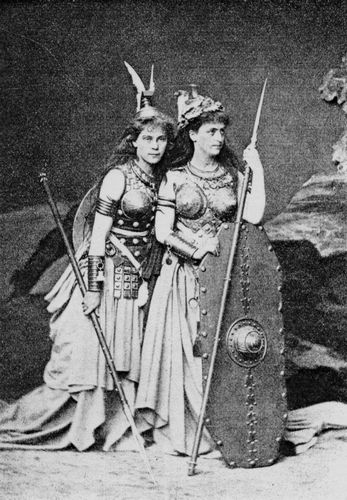
The legendary Lilli Lehmann (right), as a valkyrie.
An example of the first tradition, of keeping to Wagner's intentions.
Both of these traditions have problems – in the first, the risk of embedding the drama in a sword and sorcery fantasy world, in which deeper meanings might be missed; the second approach generally confuses through the mismatch between what is said and what is happening on stage, a confusion further heightened by the new layers of symbolism.

Keith Warner’s production is in this second tradition, and doesn’t avoid the problems I’ve mentioned. First-time Ring-experiencing companions asked me why Wotan jumped into a pit rather than lead his fellow gods upwards into Valhalla at the end of Das Rheingold. Or why the Rhinemaidens were dressed like a shabby chic variety troupe in the final act of Gotterdammerung.
 
Even if I felt I could answer these questions, they were two of perhaps two dozen that might reasonably have been asked, and I’m not confident I could answer them all – I was especially perplexed in the second act of Siegfried, with the woodbird being both a symbol of the hero’s youthful imagination and the youthful version of himself.

Maybe these confusions only enhance the attempt to achieve myth, and I did feel that Warner could have answered any question, so deeply has he thought about this production.
 
But the production also repeated several fatal mistakes that are part of this tradition, but which needn’t be – I wonder why they persist?
 
Firstly, the gods are presented as corrupt from the moment we see them, and we see a young Wotan long before Wagner intended, at the very beginning, carrying out his mutilation of the World Tree. As the gods have all of the flaws Wagner intended, but little of the compensating grandeur, they are both deeply unsympathetic and hard to distinguish from the corrupt human world of the Gibichungs in Gotterdammerung.
 
Wotan siezing the ring from Alberich, in Das Rheingold. From Royal Opera website.
As this image suggests, it isn't easy to distinguish these characters in this production.
When the concept starts like this, it is almost inevitable that the final conflagration will have to be visually bathetic – in this case gold statues of the gods being lowered into fire. An unsympathetic Wotan is even more disastrous, given the centrality of this complex character. By the end of Siegfried, he appears as a (violent) student in his bedsit, sullenly discarding his possessions in a fit of pique.

The second mistake, arriving like clockwork, is a bullying, unsympathetic portrayal of Siegfried. This is more understandable, as his characterisation needs a director of genius in order to reflect what Wagner for once cackhandedly intended. For Siegfried is the man of the future as well as dragon-conquering strongman. Not much sign of this here.

Mime's cave, first act of Siegfried. From Royal Opera website.
Where Wagner's dramatic and musical needs demanded a forest, or at least natural beauty, we see post-industrial waste.
A third mistake is for sets to be almost unremittingly ugly. I suspect the reason for this is to illustrate how, over the course of the drama, the natural world is corrupted and destroyed by our interventions, ‘our’ here being whether god, dwarf, giant or human.

So it reflects our views on ecology, which have intensified since Wagner’s time. I don’t want to suggest producers should ignore these concerns, which are absolutely in the Ring, but such a simplistic visual approach is as harmful to understanding as focussing on horned helmets and realistic dragons. 

Although I feel these three cardinal mistakes sink this production just as they sink all similar productions, I found many individual aspects to admire.

It seems that productions in the second tradition are chosen by teams with a strong commitment to realistic acting, and there were many thought-provoking moments between characters, or even whole scenes.

The Rhinemaiden scene mentioned above for instance, was charmingly comic, and an inspired interlude before things got extremely serious. Or Siegfried showing a sensitive side to Mime when the wretched dwarf is finally forced to reveal something about the hero’s parents.

Some of the symbols worked well over the course of the dramas, with the Tarnhelm later forming the Gibichung Hall; or Wotan’s Rheingold treaties forming a damning pile in the second act of Die Walkure, then appearing in the insouciant hands of the Wanderer in Siegfried; or a veil with horrible significance in Rheingold reappearing in Hagen’s case in Gotterdammerung. 

My mixed, but generally negative, feelings about the visual side of the production continue with the musical side.
 
In particular, I disliked the conducting. Antonio Pappano gave us beauty, with occasional intense or even ferocious touches, as with a magnificent Funeral March in the fourth part. But I also found myself unsettled and generally bored with the music, which implies he didn’t grasp its flow. The finale of Siegfried was especially dispiriting, with none of the soaring rhapsody I expected.
 
The singers were generally much more consistent, with Susan Bullock an especially radiant and heartfelt human Brunnhilde, though generally not convincing as a goddess in her first act.
 
Bryn Terfel’s Wotan was memorable, and for reasons consistent with the production, which is not to say I thought it did the character justice: a lot of anger, little beauty or nobility. Volke’s Siegfried was disappointing in his first act, but was clearly saving his voice, as he at least managed to sing all the way through. That this is cause for relief suggests I set the bar very low. I didn’t notice any great beauty or even variety in his voice, and his acting wasn’t a highlight.
 
Other roles varied from good to excellent, with only the Alberich and the Gunther not meeting the highest standards.

Tuesday, 2 October 2012

Edvard Munch: The modern eye


Tate Modern, 28 June - 14 October 2012
 

Edvard Munch: Self-portrait. The night wanderer. 1923-4.
Munch museet.

A major Tate Modern exhibition serves to reveal its subject as a latecomer rather than an innovator, despite its claims.

Sometimes curators claim too much for their subject, and here is a case study. Whatever might be said of Munch, I saw nothing in this exhibition to suggest he was a precursor of modernism, or modern in any other significant respect, aside from the fact he died in 1944.
 
The curators claim his aged self-portraits are unflinching depictions of his fragility, yet whether he had just experienced a life threatening illness, or was so old that death must have seemed imminent, Munch consistently portrayed himself as a hero, intense, stoic, resolute.
 

Edvard Munch: Self-Portrait: Between the Clock and the Bed 1940–3
Munch Museet

On the evidence of this exhibition, which collects photographs, woodcuts, prints, drawings, paintings, sculptures, even amateur films, the artist’s self image was the same throughout his life, at all ages. 

Given the failure of these curators to make him modern, I feel confident in asserting that Munch was a late Romantic, in fact a Decadent, his whole life, regardless of the changes that surrounded him.
 
Almost everything about his art confirms that he was born too late, with the partial exception of his chosen media, though it is clear his reputation will continue to rest on his paintings rather than his photography and films.

Some of the rooms are impressive despite contradicting the curatorial plan. A room of some of his more well-known paintings in early and later incarnations is interesting. Munch compulsively repainted his earlier ideas, though I think the general rule is: earlier is better.
 
Perhaps as time passed and he became more detached from his preferred period, which is clearly the late Romantic twilight of vampires, screams, nights and forests, the harder it became to recapture his original inspiration.

Well then, a belated figure. How does he stand, considering his concerns in themselves, so far as we can assess this? Pride, obsession, angst: these are his High Romantic themes, and as we might expect from a decadent version of romanticism, his art induces unease, claustrophobia, spleen, even nausea.
 
Colours clash; faces (or masks of such) are prominent; viewpoints are vertiginously dramatic. The exhibition is useful in showing he had more ways of achieving these effects than I thought. Not everything is wibbly-wobbly.
 
A room filled with minor variations on a single theme – a downcast near-naked woman – made me think that having a good visual idea mattered more to him than anything else, and he recreated it in various media. So at his best he is an imaginative graphic artist, with descendents in that field science fiction, comic books, poster design.  

Having a characteristic approach is a strong selling point for an artist, and Munch had that. But if we compare him with his older contemporary, Ibsen, for whose dramas he sometimes produced scenery, we discover his limitations. Munch’s best paintings reflect our doubts, our fears. Ibsen takes this basic material and uses it to investigate how we might overcome these anxieties, whether successfully or not.